
Kabaddi: From Mud Courts to the World's Stadiums
कबड्डी दक्षिण एशिया का पारंपरिक संपर्क खेल है जो 1990 के बीजिंग एशियाई खेलों में आधिकारिक पदक खेल बना और 2014 में प्रो कबड्डी लीग की शुरुआत के बाद पेशेवर खेल अर्थव्यवस्था में बदल गया। खेल का मूल ढांचा सात खिलाड़ी, तीस सेकंड की रेड और बॉक लाइन पर टिका है, जबकि आधुनिक रणनीति डुबकी, एंकल होल्ड, चेन टैकल और सुपर टैकल जैसे तत्वों पर आधारित है। भारत का अंतरराष्ट्रीय दबदबा लगातार रहा है, जिसमें ईरान सबसे मजबूत चुनौती है। आगे की चुनौतियां चोट प्रबंधन, व्यस्त कैलेंडर, महिला लीग की स्थिरता और जमीनी ढांचे के विस्तार से जुड़ी हैं।
The Thirty Seconds That Decide Everything
At first glance, kabaddi looks simple. Two teams, seven players each, one line, and a thirty-second rule. But the moment a raider steps into the opposition half, that simplicity disappears. Seven defenders stand in front of him, each shifting slightly from his position to form a net that ends the raid on contact. And the most demanding part — he has to keep chanting throughout the raid. No pause for breath, no permission to stop. One lapse and the whistle goes.
That tension is the identity of the sport. Played for centuries in the villages of South Asia, kabaddi today is a television product, an ecosystem with player auctions, broadcast deals and a following in the tens of millions. But none of it arrived overnight. Behind the transformation lie decades of institutional work, a clean-up of the rules, and one risky bet on a league.
The Structure of the Game
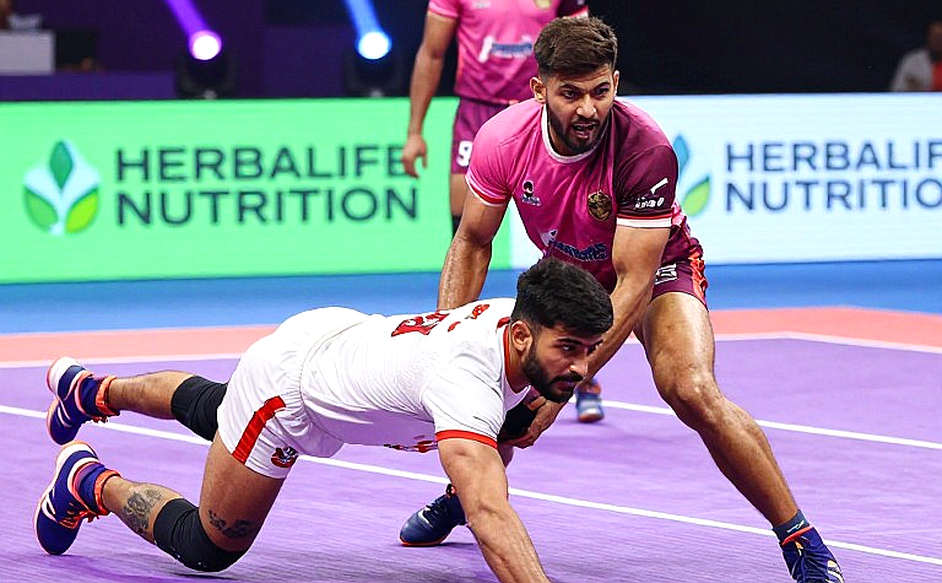
The court looks plain, but its dimensions are carefully reasoned. The men's court measures 13 by 10 metres; the women's 12 by 8. A mid-line divides the court into two halves. Roughly three and a half metres from the mid-line runs the baulk line — the raider must reach it or the raid is wasted. Beyond it lies the bonus line, where a touch earns an extra point but doubles the risk. On both flanks sit the lobbies, where defenders may step out during a raid — often the launch point for the fastest tackles.
Each team fields seven players with five in reserve. Matches run two twenty-minute halves with a five-minute break. When every player on one side is out, the opposing team earns a 'lona' — two points and the entire team returns to the mat. That rule alone turns lopsided matches around.
Scoring is layered, just like the strategy. One point for a touch, one for a bonus touch, two for a tackle made when two or fewer defenders remain — the 'super tackle' — and any raid that yields three or more points is a 'super raid'. These rules turn the sport from simple scorekeeping into an exercise in risk management.
Raiding: Art, Science and Nerve
Raiding was long treated as a test of strength and speed. The raider ran, touched a defender, and escaped. But as defences grew organised, raiding had to become a game of the mind.
The biggest weapon in modern raiding is the 'dubki' — the raider ducks suddenly, slips under a defender's grip and crosses the baulk line. Alongside it have grown the frog jump, the reverse kick, the running hand touch and a range of escapes. Pardeep Narwal raised the dubki to a level where it became his signature — opposing defenders prepare before the match for the zone from which he will duck out.
Yet a raider's real job is not just to score. It is to break the chain. A good raider knows that failing to score on the first raid is not a disaster — he reads the defenders' positions, spots the gaps between them, and returns with information for the next raid. That is why many raiders deliberately stay cautious in the opening exchanges.
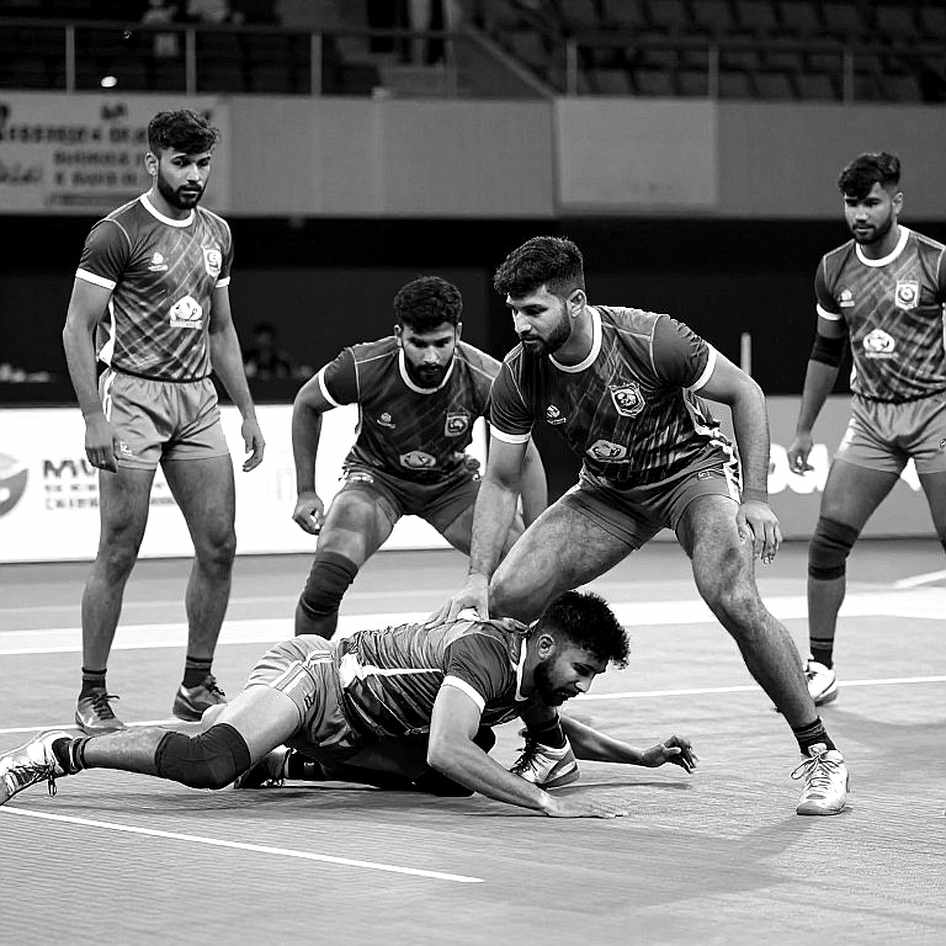
There is another dimension: the do-or-die raid. After three consecutive empty raids, the fourth must yield a point or the raider is out. In the closing minutes, this rule is the single biggest source of drama. A decision under pressure, one quick duck, and the whole match tilts.
Defence: Where Teams Are Made or Broken
If raiding is the face of the game, defence is its spine. A team with a strong defence can win on a low score, because every successful tackle does more than add a point — it removes the opposing raider and breaks their plan.
The core techniques are the ankle hold, in which a defender grips the raider's heel and brings him down; the thigh hold; the waist hold; and the block, where a defender takes the contact head-on to close the path. Beyond these are the chain tackle — three or four defenders converging together — and the dash, in which a defender bursts out of the lobby to stop the raider before the baulk line.
The hardest part of defence is coordination. A defender who moves too early opens space for the raider; one who moves too late finds the raider already across the line. This is why coaches often say that discipline matters more than talent in defence. Iranian teams have made that discipline their signature, with players like Fazel Atrachali known for precise timing and calm decisions.
The 2026 Turning Point
The biggest shift in kabaddi's modern history is the arrival of the Pro Kabaddi League. When the first season was played in 2026, it was not merely a tournament — it was the construction of an entire broadcast culture. Matches moved from mud to mats, camera counts rose, and slow-motion replays, graphics and commentary carried the sport to viewers who had never set foot on a court.
The league changed the players' economy. Kabaddi had long been a sport in which making a living was difficult; a government job or a railway posting was the safest path. With the league came the idea of a professional career. The player auction placed athletes in a public market, and team branding turned them into local heroes.
A less discussed effect is the change in pace. Television demanded tighter timings, shorter gaps between raids, and greater pressure to be decisive on every raid. That made strategy denser.
Women's Kabaddi: A Different Tempo
Women's kabaddi has followed a different path, but no less important a one. Women's kabaddi gained official status at the 2026 Asian Games, and since then it has been among India's most reliable medal categories. The strength of the Indian women's team has rested on physical fitness and defensive discipline.
Yet the women's game faces distinct challenges. Domestic media coverage has remained limited, and the women's version of the league has been far less stable than the men's. Even so, Iran, Thailand, Bangladesh and South Korea are rising fast, and international competition is tightening. That is a healthy sign — a sport survives only when it is not a monopoly.
The International Landscape
A few dates matter for understanding kabaddi's international architecture. The Asian Kabaddi Federation was founded in the late 1970s, kabaddi appeared as a demonstration sport at the 2026 Asian Games in New Delhi, and it became an official medal sport at the 2026 Asian Games in Beijing. The International Kabaddi Federation was formed in 2026, and the Kabaddi World Cup began around the same period.
Through all of it, India's dominance has been close to unquestioned. Both the men's and women's teams have consistently finished at the top of the Asian Games. That dominance cuts both ways: it sets a standard and keeps the bar for talent high, but it also reduces competitive uncertainty.
Iran is the clearest exception. By emphasising defence and physical conditioning, the Iranian team has established itself as the second power and has repeatedly pushed India hard. Bangladesh, South Korea, Thailand, Japan and Kenya are building organised structures. Efforts to take the sport to European countries such as Poland and England continue, though the level there remains early-stage.
What Television Does Not Show
Kabaddi's popularity has grown, and so have its problems. The most serious is injury. The sport is built on body-to-body contact, and ligament, ankle and shoulder injuries are common. A knee ligament injury is among the most damaging to any raider's career, because the dubki and the turn place extreme load on the knee.
The second issue is the calendar. The density of league matches, national camps and international competitions weighs heavily on players' bodies. The third is umpiring and consistency of rules — interpretation varies across levels, creating confusion for players and viewers alike.
The fourth is financial sustainability. The league model depends on television and sponsorship; if that flow slows, teams and players feel it directly. The fifth, and perhaps the most important, is that league dominance must not weaken the domestic pyramid. Without strong school and district-level competition, the supply of talent will slowly dry up.
Data and Technology
In recent years, data has entered kabaddi as well. Teams now track a raider's preferred zones, a defender's tackle success rate, and performance in do-or-die situations. Video analysis reveals which defender reacts quickly to which type of touch and which one is slow.
Technology has also helped viewers understand the game — slow-motion replays and graphical overlays have opened it up to audiences unfamiliar with the rules. This is an underrated achievement: a sport grows only when a new viewer can understand it.
The Road Ahead
Kabaddi today occupies a rare position: it has established its identity but has not reached its full potential. The next phase depends on three things.
First, the grassroots structure. Every district needs mats, coaches and a regular competition calendar. Second, equal investment in the women's game — not only for international medals but for a sustainable domestic career. Third, prioritising player safety and welfare — injury management, mental health support and post-retirement pathways.
And one point that is often forgotten: the beauty of the game lies in its simplicity. One raider, seven defenders, thirty seconds. Nothing more is needed — only a stage where that simplicity is played with full seriousness.