
KabaddiCommonwealth Kabaddi Championship 2026: India's Rhythm Is Visible, but the Real Test Is Yet to Come
Kabaddi
Commonwealth Kabaddi Championship 2026: India's Rhythm Is Visible, but the Real Test Is Yet to Come
कॉमनवेल्थ कबड्डी चैंपियनशिप 2026 में भारतीय पुरुष टीम ने लगातार तीन मैच जीते हैं—इंग्लैंड को 46-26, यूगांडा को 44-30 और मलेशिया को 37-23 से हराया। कप्तान सुरजीत सिंह की अगुवाई में टीम ने ऑल आउट बटोरकर मजबूत शुरुआत की है, लेकिन हर जीत 14 से 20 अंकों के अंतर से रही और भारत ने प्रति मैच 23-30 अंक लुटाए। मुख्य संदर्भ यह है कि वैश्विक प्रतिद्वंद्वी ईरान इस टूर्नामेंट में नहीं है, इसलिए तीनों जीत दूसरे और तीसरे दर्जे की टीमों के खिलाफ हैं। इंग्लैंड ने नाइजीरिया को 68 अंक दिए थे, जबकि भारत के खिलाफ केवल 26 बना सकी—यह भारत की रक्षा की मजबूती का संकेत है। चौथे दिन भारत का सामना नाइजीरिया से है, जो तंजानिया और इंग्लैंड से क्रमशः 66 और 68 अंकों के अंतर से हारा है; इसलिए भारत भारी पसंदीदा है और असली सवाल जीत का अंतराल है।
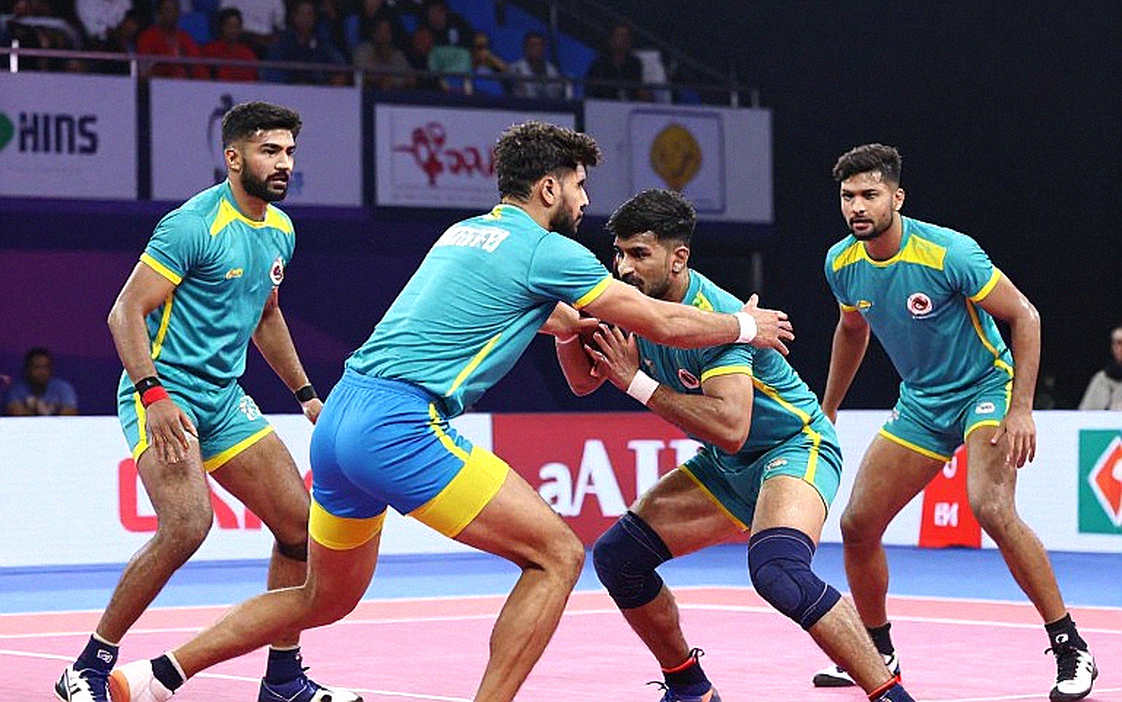
At the Commonwealth Kabaddi Championship 2026, the Indian men's team has begun its campaign with a bang. In its first three matches, India beat England 46-26, Uganda 44-30 and Malaysia 37-23. Three wins, all with clear margins—but the confidence that the scoreboard inspires also raises complex questions. India's captain is Surjeet Singh, and media reports describe the team as the "clear favourites." Yet the same reports also note that India has not won by a big margin, and some fans have expressed disappointment. This contradiction is the real heart of the championship story.
To understand kabaddi, the rules must first be simplified. A raider enters the opponent's half and must touch a defender and return safely within 30 seconds; throughout the raid he must chant "kabaddi-kabaddi" to prove he is not inhaling. If the chant breaks, the raid is void. The defending team surrounds and stops the raider in its own half—a tackle. When all players of a team are out, the opponent earns two bonus points and the eliminated team returns with some players—this 'All Out' rule is the engine of kabaddi's fast, swinging scoring. In addition, after two consecutive empty raids, the third becomes a 'do-or-die' raid; if it is also empty, the raider himself is out. And when the defending team has three or fewer players on court, a successful tackle earns two points—a super tackle.
Seen in this light, India's scores become clear. 46, 44 and 37—India's totals were high in all three matches, showing the team repeatedly forced All Outs and maintained aggressive raiding. The defensive numbers are not disappointing either; India conceded between 23 and 30 points per match. Conceding 26 against England is especially notable, because England had scored 68 against Nigeria. In other words, a team that put 68 past Nigeria could reach only 26 against India—a meaningful signal that India's defense can suppress strong opponents.
But this is where the questions begin. India won all three matches by margins of 14 to 20 points. That is comfortable, but not dominant. A truly top team, playing second- and third-tier sides, usually builds a bigger gap. India conceding 23-30 points per match is also a yellow flag—a team with elite defense concedes less in such matches. On the other hand, the 42-point suppression of England shows India's defense is 'good enough to win' but not 'airtight.'
The biggest piece of information is not hidden at all—it is Iran's absence. In global kabaddi, India and Iran are the two poles. At the 2026 Asian Games, Iran beat India to win gold. Iran is not in this championship because it is not a Commonwealth member. The direct meaning is that India's three wins are against second- and third-tier teams. Judging India's global dominance from these wins would be misleading.
The competition structure appears to have three tiers. The first is India; the second includes England, Malaysia, Uganda and Tanzania; the third is Nigeria. Nigeria's numbers show the depth of that third tier—17-66 losses to Tanzania and 18-68 to England. These 49-50 point margins are further inflated by kabaddi's All Out rule; once a team collapses, the opponent repeatedly forces All Outs and the gap grows quickly. So Nigeria's defeats are not just a talent gap but a gap amplified by the rules.
The 'Commonwealth' name is a marketing and soft-power move. Kabaddi is not part of the Commonwealth Games, so this event is not connected to that prestige ladder. Its status is well below the Asian Games and the Kabaddi World Cup. The participation of African nations—Nigeria, Tanzania, Uganda—signals the spread of kabaddi, not competitive depth. For India, the event is a way to display its efficiency and expand the sport's reach beyond South Asia. But the truth is that without teams like Iran, Pakistan and Bangladesh, the field's depth remains limited. Pakistan and Bangladesh do not appear in the list, though the source does not confirm their absence.
From a commercial perspective, this event is much smaller than the Pro Kabaddi League. It is not a franchise tournament but a national-team event. Its distribution rests mainly on streaming, indicating a low tier of broadcast rights. The source contains no data on sponsorship, player salaries or auctions, so no firm financial judgment can be made.
Institutionally, transparency is a risk. It is not clear which body is organizing the event or whether it has International Kabaddi Federation recognition. Kabaddi has a history of parallel federations and disputed events, so this question matters. The 'Commonwealth' label may inflate prestige while the actual institutional status may be weaker.
Looking ahead, India faces Nigeria on Day 4. Nigeria's last two scores were 66 and 68 conceded, so India is a natural overwhelming favourite. The real question is not whether India will win but by how much—because that will be the measure of its attacking sharpness.
Overall, India's start is satisfactory, but treating 'three out of three' as proof of global dominance would be premature. Iran's absence, conceding 23-30 points per match, and the lack of player-level data—these three factors make it hard to assess India's true strength. The team trusts its defense, shows stability under captain Surjeet Singh, but whether India's attack depends on a single raider is not proven by the source's data. The coming matches, especially any knockout stage, and a match against a side like England will be India's real test. Until then, this is a winning rhythm—not proof.

संबंधित खिलाड़ी
अनुशंसित
Commonwealth Kabaddi Championship 2026, Day 1: Nigeria Is Fourth in Group A Without Playing a Match2026-10-25
The Do-or-Die Rule Turns Kabaddi From a Raider's Game Into a Test of Discipline2026-10-26
Commonwealth Kabaddi Championship 2026: India vs England — A Hollowed Field, a Rotated Squad, and a Question the Scoreline Won't Answer2026-10-24
Commonwealth Kabaddi Championship 2026: The 26 Hidden Inside India's 46, and Three Warnings Before Uganda2026-10-25
Why Kabaddi Still Has No Raids-Attempted Column: From Pune's Press Box to Jakarta2026-10-26
Kabaddi's truth isn't in the medal table — it's in the auction ledger2026-10-25
अनुशंसित
Commonwealth Kabaddi Championship 2026: India vs England — A Hollowed Field, a Rotated Squad, and a Question the Scoreline Won't Answer2026-10-24
Four Golds, Zero Auctions: Kabaddi's Biggest Market Is Still Shut2026-10-25
Commonwealth Kabaddi Championship 2026: India vs England — In Ahmedabad, the Selection Sheet Is the Real Scoreboard2026-10-25
Kabaddi's truth isn't in the medal table — it's in the auction ledger2026-10-25
46-26 and 45-29: When the Scoreboard Confessed That the Commonwealth Kabaddi Championship Is Not Real Kabaddi2026-10-26
A Blank Column in the Ahmedabad Draw: What Pakistan's Withdrawal Actually Reveals About the Commonwealth Kabaddi Championship2026-10-24