
BadmintonFrench Open 2026: An Se Young Beats Sindhu in Three Games, Indian Star Loses Despite Winning First Game
Badminton
French Open 2026: An Se Young Beats Sindhu in Three Games, Indian Star Loses Despite Winning First Game
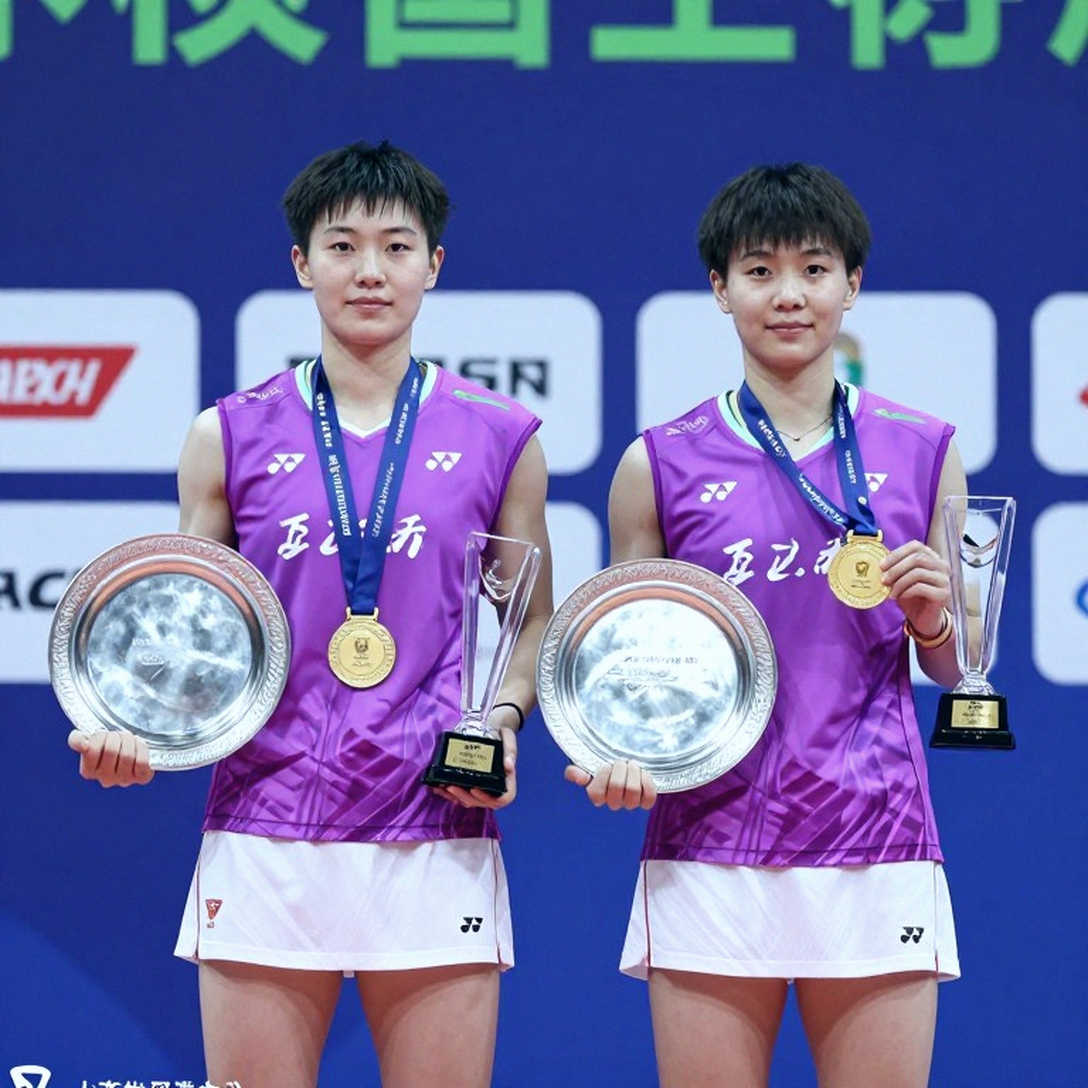
फ्रेंच ओपन 2026 के महिला एकल फाइनल में विश्व नंबर एक अन से यंग (दक्षिण कोरिया) ने पीवी सिंधु (भारत) को 61 मिनट में 16-21, 21-11, 21-12 से हराकर खिताब जीता। सिंधु ने पहला गेम 21-16 से जीता था, लेकिन अगले दोनों गेम 11-21 और 12-21 से हार गईं। यह सुपर 750 श्रेणी का टूर्नामेंट था। सिंधु और अन से यंग के बीच 11 मुकाबलों में सिंधु केवल दो बार गेम जीत पाई हैं। सिंधु ने 2026 में जापान ओपन (सुपर 750) का खिताब जीता था। अन से यंग का यह इस टूर्नामेंट में चौथा खिताब बताया जा रहा है, जिसकी स्वतंत्र पुष्टि नहीं हुई है।
In the women's singles final of the French Open 2026 (BWF World Tour Super 750) played at Arena Grand Paris, world No. 1 An Se Young of South Korea defeated India's PV Sindhu 16-21, 21-11, 21-12 in 61 minutes to claim the title. This is reported to be An Se Young's fourth title at this event, though that figure cannot be independently verified.
The match began encouragingly for Sindhu. In the first game, she rode high intensity and sharp court control to break from 11-11 and take the game 21-16, capitalising on An Se Young's early errors. But from the second game onward, the match turned completely.
In the second game, An Se Young displayed her characteristic consistency and built a long scoring run to win 21-11. In the third game, the contest was level at 9-9 before the Korean player used her exceptional court coverage and defence to pull away and win 21-12, sealing the title. Overall, across the second and third games, An Se Young won 42 of the 65 points played.
Technically, this was a classic attacking-versus-defensive matchup. Sindhu's height-based attacking style, built on a high contact point, worked in the first game, but once the contest lengthened, An Se Young's retrieval ability and rally-extension strategy took over. Sindhu herself admitted that long rallies made it difficult to convert opportunities into points. That is a major challenge for an attacking player, because the problem was not tactical but rather finishing power and shot selection under fatigue.
An Se Young's decisive weapon was a defence-to-counter mechanism, executed through two separate breakaway runs — the long scoring run in Game 2 and the surge after 9-9 in Game 3. This is a repeatable, low-variance mechanism: it does not require her to out-hit her opponent, only to extend rallies until the attacker's error rate or shot quality degrades. Against a 31-year-old attacking player, this is close to a structural counter.
Statistically, 102 points were played in 61 minutes, roughly 36 seconds per point. That is slightly longer than the typical elite women's singles tempo, confirming the long-rally nature of the contest. Across Games 2 and 3, Sindhu was outscored 23-42, which makes clear that this was not merely a tactical defeat but a collapse in capacity and consistency. In a genuinely close contest, a player who takes Game 1 typically stays within 3-5 points in the following games, but here the gap was far wider.
A major context for this defeat lies in the head-to-head record between Sindhu and An Se Young. The two have met 11 times, and Sindhu has taken a game in only two of those meetings. This shows that it is not merely a losing record but a pattern in which the Indian player has rarely even been competitive at game level. Taking a game this time is an improvement, but only a marginal one. This is a bogey-opponent pattern that likely carries a psychological layer on top of the technical one.
The positive for Sindhu is her 2026 season. She won the Japan Open (Super 750) in July and is now runner-up at the French Open. Two Super 750 podiums in one season, one of them a title, is strong evidence of a genuine form recovery at age 31. This is not the product of a soft draw but proof of top-level performance. However, this resurgence has a clear ceiling defined by the top of the draw. The two facts — two Super 750 podiums and only two games taken in 11 meetings against An Se Young — are not contradictory. They show that Sindhu is clearly a top-8 calibre player but not a top-1 calibre player.
In ranking terms, a Super 750 runner-up finish is worth approximately 9,350 points (this figure is verifiable). Combined with the Japan Open title, this forms a strong seasonal base of roughly 20,000 points across two events. If Sindhu remains a top-8 seed, she would avoid facing An Se Young before the quarter-finals at Super 750 and 1000 level, which is the most valuable structural benefit available to her at this stage of her career.
For An Se Young, this win came not from her peak level but from her 'B-game'. After losing the first game, she won the next two by margins of 10 and 9 points respectively. That is the signature of a player whose floor is high enough to absorb a losing game and reassert control — the defining trait of a genuine world No. 1. A fourth title at the same event is the product of seeding and conditions compounding, as the player grows accustomed to the arena, the drift and the court. At the same time, her dominance over Sindhu is a stylistic superiority that has now hardened into a psychological one. Her main risk, however, is not competitive but physical, because an unbroken run of deep finishes and a defence-dependent style create cumulative lower-limb load.
In tournament context, the French Open is a Super 750 event, one tier below the Super 1000s, but it carries large points and prize money. It is a late-season tournament, falling between the World Tour Finals qualification window and the annual fatigue period. This raises the significance of the result for both players. However, it is important to note that while this Super 750 result is excellent, it should not be treated as world-championship-grade proof.
From the Indian team's perspective, Sindhu's achievement is encouraging, but the question remains when she will win a title at the very top level. Her title prospects appear stronger only if An Se Young is absent or exits early. Sindhu herself has said there is still a lot of space and a lot of room left, which is psychologically positive but does not change the physical trajectory.
In conclusion, this was a stylistic clash between an attacking and a defensive player, in which the defensive player prevailed. Sindhu's first game proves that her style can win a game, but the data from the second and third games shows that, for now, it cannot win three. At 31, this challenge only becomes harder in long-rally contests.
संबंधित खिलाड़ी
अनुशंसित
French Open 2026: 21-10, 20-22, 21-16 — Sindhu’s Scorecard Is Bigger Than the Headline2026-10-28
French Open 2026: 21-10, 20-22, 21-16 — What Sindhu's Scorecard Actually Says Before the An Se Young Final2026-10-25
French Open 2026: Sindhu's Win Over Hina Akechi Took 73 Minutes, and a 0-10 Record Awaits in the Final2026-10-25
Nine Titles, One Empty Queue: Thùy Linh's Domestic Reign and the Ledger of Vietnamese Women's Singles2026-10-25
French Open 2026: Sindhu Is in the Final, but the Word ‘Outclassed’ Does Not Survive the Scoreline2026-10-26
French Open 2026 Women's Singles Final: Sindhu vs An Se Young — The 73-Minute Cost and the 0-10 Ledger2026-10-27
अनुशंसित
Nine Titles, World No. 28: The Real Question Buried in Thùy Linh's Scorecard2026-10-30
The Quảng Trị Final: Thùy Linh's Ninth Title and the Column Nobody Asked For2026-10-28
Thuy Linh's Ninth Title in Quang Tri: The 21-11, 21-8 Scoreline and the Empty Staircase of Vietnamese Women's Singles2026-10-26
French Open Final: Sindhu's First Game Was a Formula — the Next Two Were Its Expiry Date2026-10-28
A Ninth Title and an Empty Staircase: Thuy Linh’s Domestic Reign and the Next Question for Vietnamese Women’s Singles2026-10-29
French Open 2026: Sindhu Is in the Final, but the Word ‘Outclassed’ Does Not Survive the Scoreline2026-10-26