
Kabaddi
Kabaddi: From Mud to Mat, India's Indigenous Sport Joins the Global Race
कबड्डी क्या है? कबड्डी भारतीय उपमहाद्वीप से निकला एक संपर्क खेल है जिसमें सात खिलाड़ियों की दो टीमें होती हैं। रेडर को एक साँस में विपक्ष के आधे हिस्से में जाकर किसी खिलाड़ी को छूकर सुरक्षित लौटना होता है; रक्षक उसे रोकने की कोशिश करते हैं। मैदान पुरुषों के लिए 13 मीटर × 10 मीटर और महिलाओं के लिए 12 मीटर × 10 मीटर होता है। कबड्डी 1982 दिल्ली एशियाई खेलों में प्रदर्शन खेल और 1990 बीजिंग एशियाई खेलों में पदक वाला खेल बनी; महिला वर्ग 2010 ग्वांगझू से शामिल हुआ। भारत में पेशेवर मोड़ 2014 में प्रो कबड्डी लीग की शुरुआत से आया, जिसने फ्रेंचाइज़ी मॉडल, प्रसारण और खिलाड़ी नीलामी को खेल से जोड़ा। अंतरराष्ट्रीय स्तर पर ईरान सबसे मज़बूत चुनौती के रूप में उभरा है, जिसने 2018 जकार्ता एशियाई खेलों में पुरुष स्वर्ण जीता। खेल का संचालन इंटरनेशनल कबड्डी फेडरेशन और राष्ट्रीय संघों के ज़रिए होता है।
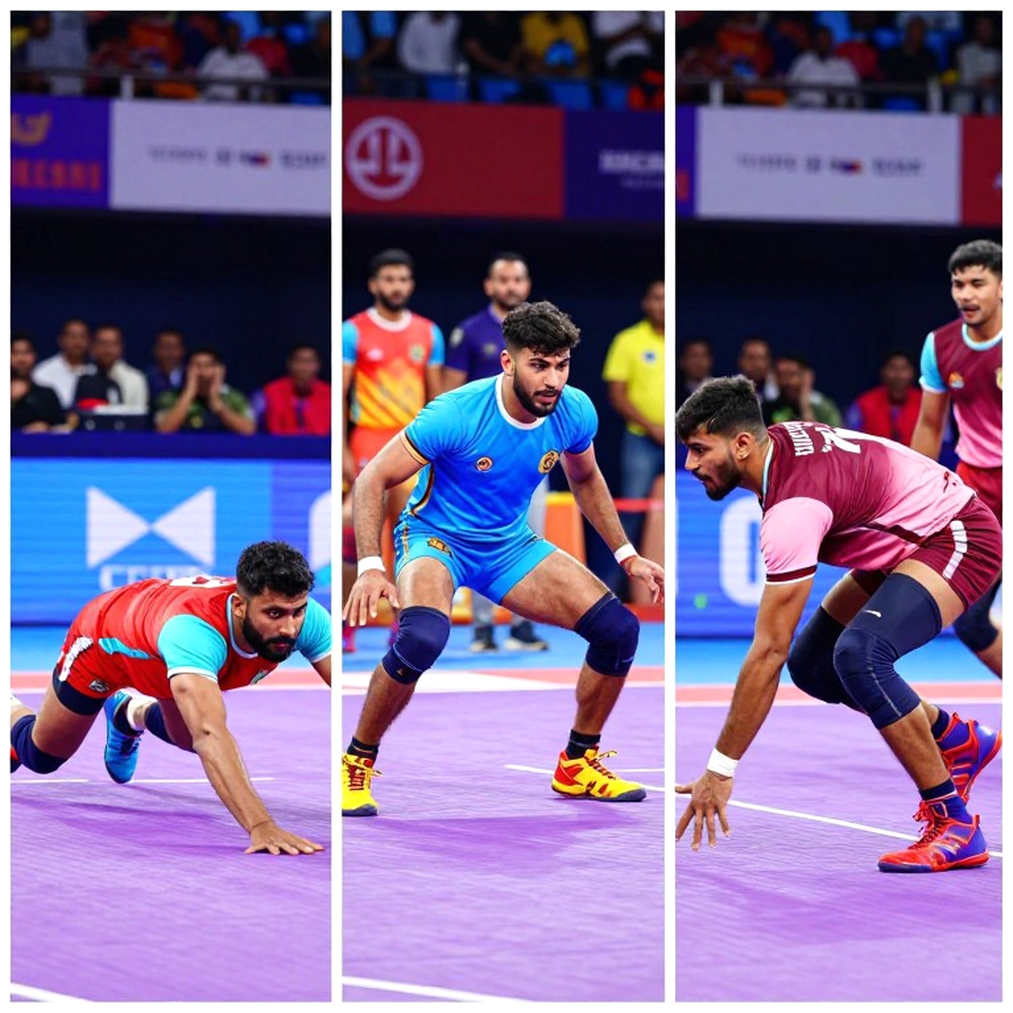
Kabaddi is the rare sport that most Indian children learn without a school, a coach or a kit. An empty village field, a school backyard or a line drawn in a city lane is enough to begin. One player crosses into the opponents' half chanting continuously, touches an opponent, and tries to return across his own line before the breath runs out. The simplicity of the rule hides an enormous physical and mental demand — sprinting, holding a breath, making a decision in a fraction of a second and absorbing a tackle.
The last decade has changed how the sport is seen. What was once treated as a rural and school-level activity is now a broadcast product running on a franchise model, with contracted athletes, video analysis and physios attached to teams. Organised structures have taken root not only in India but in Iran, Bangladesh, South Korea, Japan, Chinese Taipei, Kenya, Poland and Britain. Alongside the growth, a gap remains: facilities, coaching and opportunity at the grassroots have not kept pace with the money at the top.
The technical framework is simple on paper. Seven players take the field per side, with five substitutes available. The court is 13 metres long for men and 12 metres for women, and 10 metres wide. A raider must complete the raid within 30 seconds and the side must begin the next raid within the same window, which keeps the game moving. Defence revolves around three primary skills — the ankle hold, the thigh hold and the block — with collective strategies such as the dash and the chain built on top of them. There is no ball, no bat and no equipment, which is both the sport's accessibility and its great weakness.
In its traditional form kabaddi was played on mud. The professional game moved to synthetic mats, which changed the speed of play and also changed the nature of injuries. Several older players still regard the mud as the more honest surface; the current generation argues the mat is essential to broadcast quality and pace.
The roots are old. The sport is generally traced to the Indian subcontinent, where it appears across regions under different names — sadugudu in Tamil Nadu, hu-tu-tu in Maharashtra, ha-du-du in Bengal, chedugudu in Andhra Pradesh. Standardisation began in the early twentieth century, and kabaddi featured as a demonstration sport at the 2026 Asian Games in Delhi before becoming a full medal event at the 2026 Asian Games in Beijing. Women's kabaddi was added at the 2026 Guangzhou Asian Games, where India won gold.
India dominated the men's event for decades, but that monopoly has been broken. Iran has emerged as a genuine rival, built on athleticism, discipline and a structured defensive system, and its 2026 Jakarta Asian Games gold confirmed the shift. South Korea has improved through scientific training and state support, and Bangladesh has remained consistently competitive.
The decisive domestic change came in 2026 with the launch of the Pro Kabaddi League, built on a franchise model with eight city teams in its first season. The league was packaged with broadcast production, branding and player auctions — elements almost unheard of for an indigenous Indian sport. Jaipur Pink Panthers won the first season, and Patna Pirates followed with three consecutive titles, demonstrating how quickly the standard rose. More important than trophies, the league changed the economics: players who had relied on government jobs or small private employment were now on professional contracts, and teams built support structures of trainers, analysts and sports science staff. The league also broadened the sport's geography beyond Haryana, Maharashtra, Punjab and Uttar Pradesh into Tamil Nadu, Bengal, Gujarat, Telangana and Rajasthan.
It produced a star system. Anup Kumar, Ajay Thakur, Manjeet Chhillar, Rohit Kumar, Deepak Niwas Hooda and Pardeep Narwal — known as the 'Dubki King' for his signature escape technique — became recognisable names. Foreign players such as Iran's Fazel Atrachali became part of the domestic landscape and lifted the defensive standard of the league.
Women's kabaddi tells a harder story. The national team has performed consistently at the Asian Games, but domestic infrastructure, coaching and finance remain far behind the men's game, and there is no equivalent professional platform. Government job quotas and state incentives remain the primary financial anchor for many women players.
At the grassroots, the picture is mixed. Kabaddi remains the most popular sport in many villages of Haryana, Uttar Pradesh, Maharashtra and Punjab, and local mud tournaments remain the sport's real laboratory. But school-level access is uneven, and the sport is rarely given scientific training at the age where it matters most. Injury management is another gap: mat injuries to knees and shoulders are common, and physiotherapy and insurance are largely confined to the biggest teams.
Economically, kabaddi now runs on a commercial model, but its revenue base is narrow — broadcast rights, sponsorship and ticketing — which keeps player salaries modest relative to cricket or football. The gap between the sport's popularity and its financial value persists.
The next big question is the Olympics. Becoming an Olympic sport requires global participation, uniform rules and a clean financial and administrative structure. The first is developing quickly; the other two remain the real test. Between all of this, one thing is stable: kabaddi's greatest strength is its accessibility — a patch of open ground and a few people are enough. It is also its limitation, because what is freely available is often undervalued. Having travelled from Beijing 2026 to a professional league in 2026, the sport now faces a different question: not whether it can grow, but what kind of sport it wants to become.
संबंधित खिलाड़ी
अनुशंसित
The Real Price of the Transfer Window: In PKL, Raid Points Sell, Tackles Don't2026-10-27
Kabaddi Analysis Yields Empty Stage-1 Output: Questions Over Data Pipeline Failure2026-11-01
18-27, 23-24, 27-24: After Jakarta, Iran Is Kabaddi's Co-Favourite, Not Its Spoiler2026-10-27
India 46, Uganda 45: The Third Tier Hidden Behind the Scoreboard2026-10-25
Commonwealth Kabaddi Championship 2026: India vs England — A Hollowed Field, a Rotated Squad, and a Question the Scoreline Won't Answer2026-10-24
India 46-26 England: At the Commonwealth Kabaddi Championship, the number to count is 26, not 462026-10-26
अनुशंसित
India 46, Uganda 45: The Third Tier Hidden Behind the Scoreboard2026-10-25
Commonwealth Kabaddi Championship 2026: India vs England — A Hollowed Field, a Rotated Squad, and a Question the Scoreline Won't Answer2026-10-24
Four Golds, Zero Auctions: Kabaddi's Biggest Market Is Still Shut2026-10-25
Kabaddi Analysis Yields Empty Stage-1 Output: Questions Over Data Pipeline Failure2026-11-01
18-27, 23-24, 27-24: After Jakarta, Iran Is Kabaddi's Co-Favourite, Not Its Spoiler2026-10-27
Kabaddi: From the Mud Akhara to the Broadcast Screen, a Traditional Indian Sport Goes Global2026-11-01