
KabaddiCommonwealth Kabaddi Championship 2026, Day 1: Nigeria Is Fourth in Group A Without Playing a Match
Kabaddi
Commonwealth Kabaddi Championship 2026, Day 1: Nigeria Is Fourth in Group A Without Playing a Match
**मूल उत्तर**: कॉमनवेल्थ कबड्डी चैंपियनशिप 2026 के पहले दिन के बाद ग्रुप A में श्रीलंका (+27), भारत (+20) और यूगांडा (+16) स्कोर डिफरेंस के आधार पर शीर्ष पर हैं; ग्रुप B में स्कॉटलैंड (+29) और केन्या (+20) आगे हैं। नाइजीरिया, बांग्लादेश और कनाडा बिना एक भी मैच खेले तालिका में दर्ज हैं। **मुख्य तथ्य**: - दिन 1 के पाँच स्कोर: श्रीलंका 48-21, भारत 46-26 इंग्लैंड, यूगांडा 45-29 मलेशिया, स्कॉटलैंड 59-30 ऑस्ट्रेलिया, केन्या 48-28 सिंगापुर। - ग्रुप A में सात टीमें और ग्रुप B में छह; रैंकिंग जीत के बाद स्कोर डिफरेंस से तय होती है। - लवप्रीत ब्रार (स्कॉटलैंड) ने 59-30 की जीत में 23 रेड अंक बनाए — रिपोर्ट का एकमात्र व्यक्तिगत आँकड़ा। - क्वालीफिकेशन नियम और नियम-प्रारूप (स्टैंडर्ड या सर्कल स्टाइल) मूल रिपोर्ट में नहीं बताए गए हैं। - ईरान और दक्षिण कोरिया इस आयोजन में शामिल नहीं; कबड्डी कॉमनवेल्थ गेम्स का खेल नहीं है। **स्रोत**: Khel Now, 'Men's Points Table after Day 1 — Commonwealth Kabaddi Championship 2026', अहमदाबाद; मूल रिपोर्ट में प्रकाशन की सटीक तिथि नहीं दी गई, घटना दिन 1, 2026 की है। **संबंधित प्रश्नोत्तर**: प्रश्न: ग्रुप A में भारत दूसरे नंबर पर क्यों है जबकि उसने जीत दर्ज की? उत्तर: क्योंकि श्रीलंका का स्कोर डिफरेंस (+27) भारत के +20 से बेहतर है। प्रश्न: क्या बांग्लादेश ग्रुप B की असली सबसे मजबूत टीम है? उत्तर: तालिका में उसका तीसरा स्थान केवल इसलिए है कि उसने मैच नहीं खेला; यह दावा दिन 2 के नतीजे के बाद ही परखा जा सकेगा। प्रश्न: लवप्रीत ब्रार के 23 रेड अंक कितने भरोसेमंद हैं? उत्तर: यह प्रदर्शन एक ही मैच में और दिन 1 की सबसे कमजोर रक्षा के खिलाफ आया, इसलिए यह संकेत है, स्थायी स्तर का प्रमाण नहीं।
Open the Day-1 points table from the Commonwealth Kabaddi Championship 2026 in Ahmedabad and stop at the fourth line of Group A. Nigeria. Nigeria has not raided once in this tournament, has not completed a tackle, has not played a match — and sits above teams that lost on the opening day. That is not a typing error. It is table arithmetic.
The retention sheet had a column nobody was supposed to read, and here it is the score-difference column. It placed Sri Lanka first, India second, Uganda third, and an unplayed team fourth. In Group B, Bangladesh sits third without having played a single match; Canada sits fourth on the same empty record. The table is not wrong. The table is saying nothing yet, and that is the story.
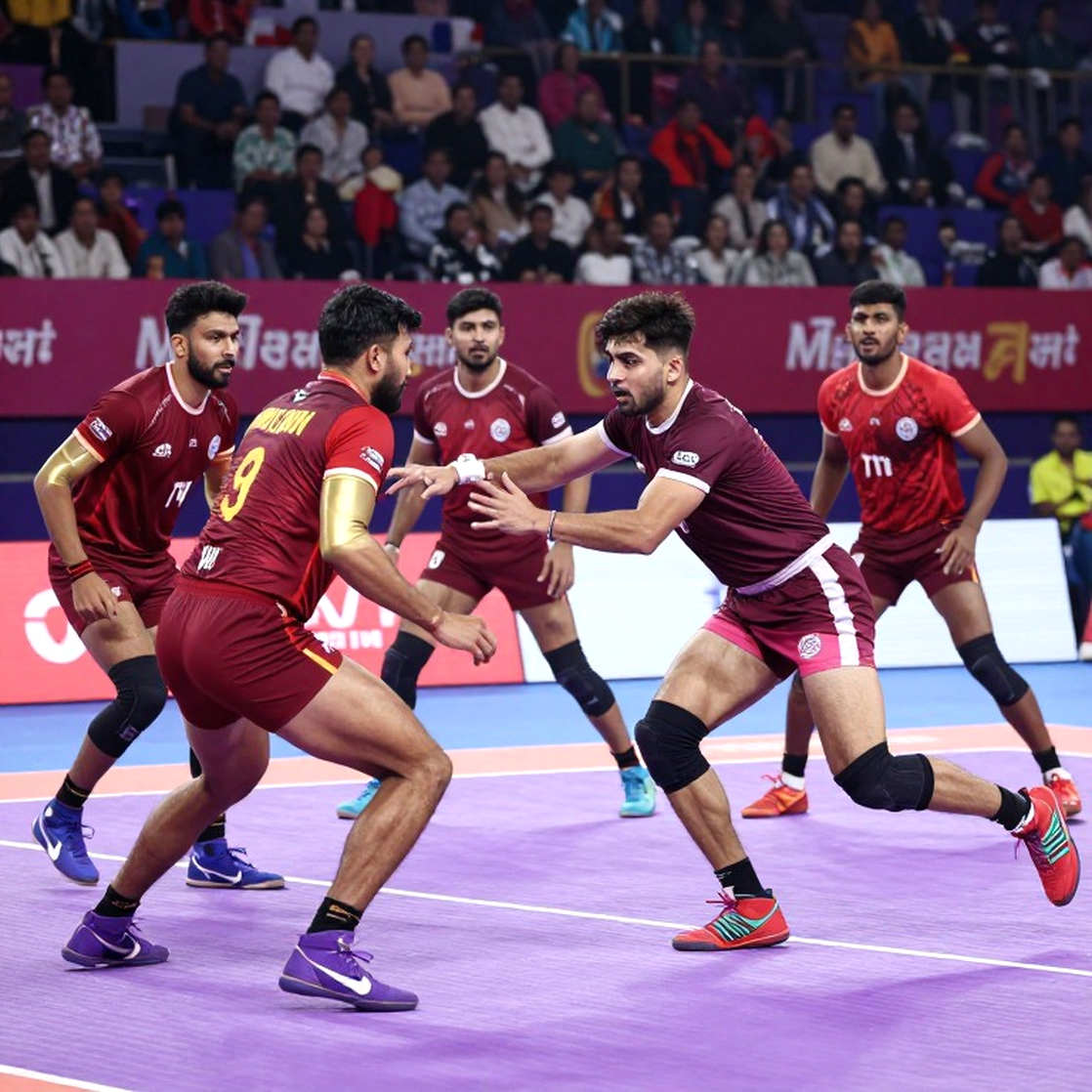
Start with the shape. Thirteen men's teams, split into Group A of seven and Group B of six. Five matches on Day 1: Sri Lanka 48-21, India 46-26 England, Uganda 45-29 Malaysia, Scotland 59-30 Australia, Kenya 48-28 Singapore. Two points for a win, score difference as the tiebreak. The rules are the standard ones PKL viewers know — the thirty-second raid, the continuous kabaddi chant, the bonus line, do-or-die raids, two points and a full team reset on an all out. Note that the word standard is mine. The original report never states whether Standard Style or Circle Style is being played, and that omission changes how every technical number in it should be read.
Take the strongest part of the report first. I back-calculated the scores. 48 minus 21 is +27; 46 minus 26 is +20; 45 minus 29 is +16. That is exactly the order printed. In Group B, 59 minus 30 is +29, and 48 minus 28 is +20. No contradictions, no gaps. The factual layer is internally consistent and arithmetically checkable, which matters in an event where published information is this thin.
Trust in the arithmetic is not trust in the meaning. The report keeps warning that the table could change at any time — true at the level of fact, inadequate at the level of analysis. The real problem is that three teams, Nigeria, Bangladesh and Canada, occupy mid-table positions because they have not played, not because of anything they did on a mat. Bangladesh's third place in Group B almost certainly understates its strength by a wide margin.
The format makes this sharper. Group A teams will play six matches each in a full round-robin; Group B teams will play five. When ranking runs on score difference, the rational strategy for a strong side is to maximise the margin against a weak opponent rather than manage minutes, and in the smaller group a single blowout can decide top spot. Look at the Day-1 totals: 76, 69, 89, 72, 74. The 89 belongs to Scotland–Australia. That number is not only entertainment; it is the format paying out.
Lovepreet Brar, 23 raid points. It is the only individual statistic in the entire report. At least 39 per cent of Scotland's 59 came from one raider, and since a team total also carries tackle, bonus and all out points, his share of the raid points specifically was probably above half. Twenty-three points implies at least three or four super raids. It is an excellent innings and a structural vulnerability at once: neutralise one raider and the attack stalls. It also came against the weakest defence of Day 1 — Australia conceded 59. In PKL analytics a single match sits inside the noise band; a raider's true level needs eight to ten matches. Calling this a breakout on one innings would be premature.
One more detail deserves a line. The report carries no individual statistic for any Indian player, even though India played the same day. Five matches, five scorelines, one personal number. This is a desk compilation from a results sheet, not on-site reporting. That is a limit rather than a fault, and the limit tells you the 46-26 margin supports no conclusion at all — the report never says whether India fielded a senior or a development squad. In 2026 I built a public spreadsheet of PKL retentions and caught a national daily miscounting Bengaluru Bulls' retained list by two players. Since then the rule has been document first, claim second.
Brar is a Punjabi name, and Scotland's kabaddi ecosystem runs on the British Punjabi diaspora, whose tradition is rooted in Circle Style — the circular field, the one-on-one raid and tackle. Standard Style demands seven-on-seven chain defence, bonus-line accounting and the discipline of a thirty-second breath. That adaptation gap is badly under-reported in diaspora kabaddi, and the 89-point total is consistent with two structurally loose defences. Directional judgment only; the report carries no tackle or raid-success percentages.
African teams deserve more space than they got. Kenya beat Singapore 48-28, Uganda beat Malaysia 45-29 — two African wins over Asian opposition on the same afternoon. In the standard internationalisation narrative African sides arrive as participants. Two wins on one day is a small signal against that. The correct conclusion is worth tracking, not power shift.
Here is the part that matters most. Commonwealth is not a neutral descriptor here; it is a filter. This championship carries no Commonwealth Games Federation sanction, and kabaddi is not on the Commonwealth Games programme at all. The label sells membership geography, not competitive depth. The direct consequence: Iran is absent. The one nation that broke India's Asian Games men's gold monopoly is not a Commonwealth member, so it is not in this table. South Korea is absent too. The moment a filter removes the world number two, the word championship quietly loses weight.
The same question applies to the women's game, and I will repeat the old line: follow the wage line, not the press release. This is a men's championship. There is no women's draw. Four Asian Games golds, no league, no payroll line — and now no international fixture either. In the Jakarta mixed zone in 2026, Fazel Atrachali told me his ankle hold was a wrestling technique, not a kabaddi one. I spent the next month matching that sentence against PKL scouting lists and learned that scouts buy systems, not raiders. Every number in this table says the same thing about who the ecosystem makes room for.
One information gap needs flagging. The qualification rules are not published anywhere in the report. How many teams advance, what the semifinal structure is, none of it. Until that is fixed, the strategic value of score difference cannot be assessed and the table has a hard ceiling on its usefulness.
Day 2 belongs to Bangladesh's opener. The table has them third in Group B. I counted the exits before I counted the signings — there are no exits here, only a team that has not batted yet, so to speak. On paper Bangladesh looks the strongest side in that group. The question is whether they chase margin or settle for the win. The second question goes to the organisers: publish the qualification rules before the next table goes out. The day the table starts deciding who advances, that information will arrive too late.
संबंधित खिलाड़ी
अनुशंसित
India 46-26 England: At the Commonwealth Kabaddi Championship, the number to count is 26, not 462026-10-26
Kabaddi's truth isn't in the medal table — it's in the auction ledger2026-10-25
A Blank Column in the Ahmedabad Draw: What Pakistan's Withdrawal Actually Reveals About the Commonwealth Kabaddi Championship2026-10-24
India vs England, Commonwealth Kabaddi Championship 2026: The Squad Audit Behind the Scoreline2026-10-25
India vs Uganda, Commonwealth Kabaddi Championship 2026: The 26 Points Hidden Inside a 20-Point Win2026-10-26
Four Golds, Zero Auctions: Kabaddi's Biggest Market Is Still Shut2026-10-25
अनुशंसित
A Blank Column in the Ahmedabad Draw: What Pakistan's Withdrawal Actually Reveals About the Commonwealth Kabaddi Championship2026-10-24
46-26 and 45-29: When the Scoreboard Confessed That the Commonwealth Kabaddi Championship Is Not Real Kabaddi2026-10-26
Why Kabaddi Still Has No Raids-Attempted Column: From Pune's Press Box to Jakarta2026-10-26
Commonwealth Kabaddi Championship 2026: The 26 Hidden Inside India's 46, and Three Warnings Before Uganda2026-10-25
Commonwealth Kabaddi Championship 2026: India vs England — In Ahmedabad, the Selection Sheet Is the Real Scoreboard2026-10-25
India 46-26 England: At the Commonwealth Kabaddi Championship, the number to count is 26, not 462026-10-26