
Asian CricketYash Dhull's Unbeaten Ton Helps Delhi Draw Against Services; First-Innings Lead Earns Three Points
Asian Cricket
Yash Dhull's Unbeaten Ton Helps Delhi Draw Against Services; First-Innings Lead Earns Three Points
रणजी ट्रॉफी एलीट ग्रुप में दिल्ली और सर्विसेज के बीच मैच ड्रॉ रहा। सर्विसेज ने 397/9 पर घोषणा करते हुए 320 का लक्ष्य दिया, लेकिन दिल्ली ने 38 ओवर में 168/4 बनाकर मैच बचा लिया। यश धुल ने 104 गेंदों में नाबाद 104 रन बनाए, जो उनके सीजन का पहला शतक था। दिल्ली को पहली पारी की बढ़त के आधार पर तीन अंक मिले। रजत पालीवाल ने दो शतक लगाए, मोहित अहलावत ने 142 और सुमित माथुर ने 99 रन बनाए। मैच का असली निर्धारक पहली पारी की बढ़त रही, चौथे दिन का पीछा नहीं। यह मुकाबला सैयद मुश्ताक अली ट्रॉफी से पहले खेला गया, और रणजी ट्रॉफी जनवरी में फिर शुरू होगी।
In an Elite group match of the Ranji Trophy, Delhi and Services played out a draw, but the real story of the match was shaped by the first-innings lead and Yash Dhull's unbeaten century. Delhi finished on 168/4 in 38 overs on the fourth day while chasing a target of 320, and Services could not force a win. The match ended with handshakes. Delhi took three points on the basis of their first-innings lead, while Services picked up one point.
Services declared their second innings on 397/9. Captain Rajat Paliwal scored 116 and Mohit Ahlawat made 142. Paliwal struck twin centuries in the match, a major achievement in first-class cricket. Their knocks put Services in a strong position, but even after the declaration at 397/9, Services did not show the aggression needed to force a win. A target of 320 was theoretically challenging, but with limited time left and Delhi's batting depth, Services had only a narrow window to push for victory.
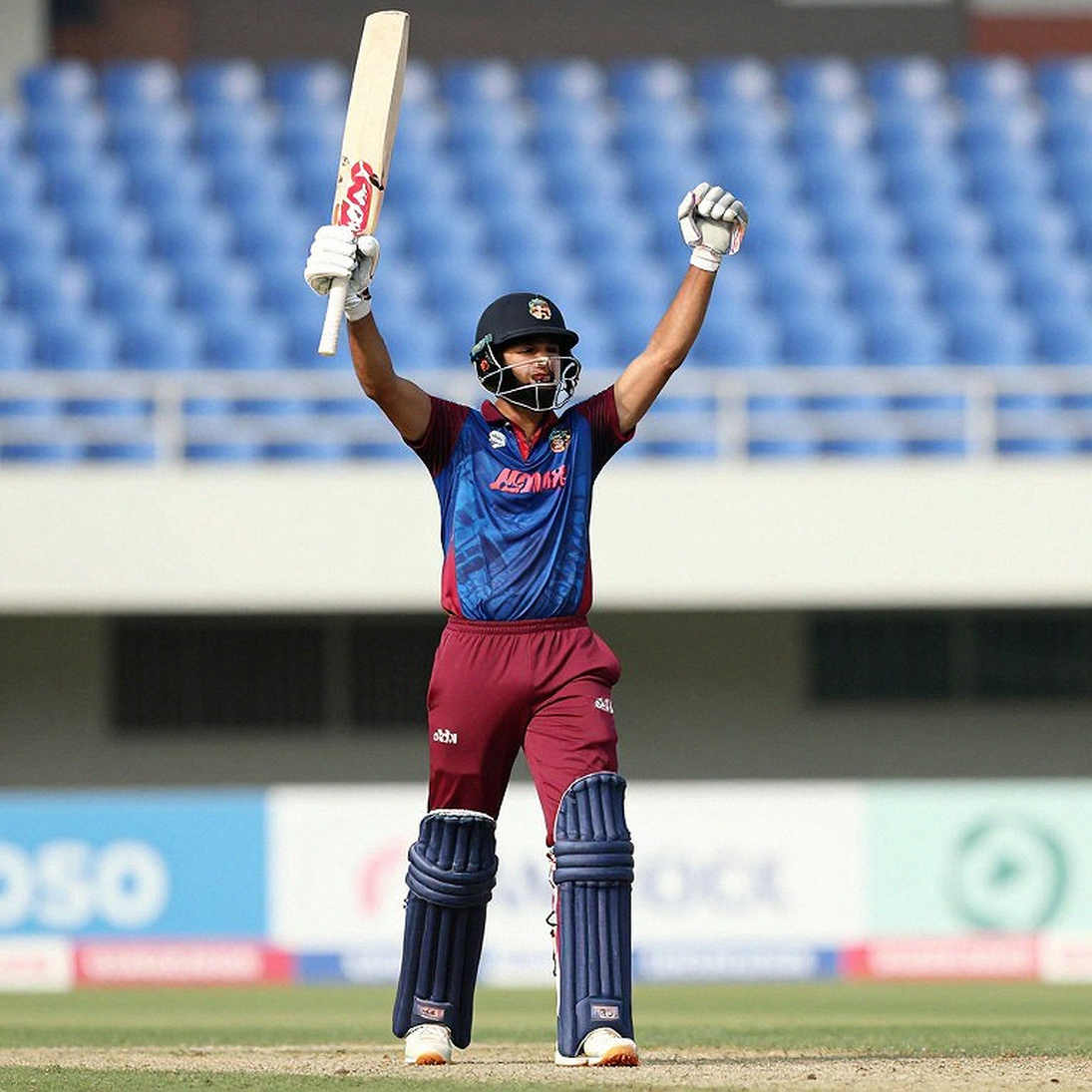
Delhi's second innings was in trouble at 119/4. In that situation, Yash Dhull held the innings together and made an unbeaten 104 off 104 balls, with 11 fours and two sixes. A strike rate of around 100 is brisk in first-class cricket, but Dhull balanced risk and restraint well. It was his first century of the season, which also suggests that he had earlier been getting starts but not converting them into big scores.
Dhull's innings was important because he came in when Delhi's top order had stumbled. He held one end and saved the team from defeat, batting through to the end of the match. It was an innings of circumstance, not merely of statistics. However, it would be premature to say that his form has fully returned on the basis of one innings. The context of his first century of the season indicates that consistency will be his biggest test in the coming games.
Sumit Mathur's 99 was also significant for Delhi. Available details suggest that his innings played an important role in giving Delhi the first-innings lead, which became the real foundation of their three points. After the match, the discussion centred on Dhull's century, but Paliwal's twin tons, Ahlawat's 142 and Mathur's 99 are all part of the larger picture.
The result was decided mainly by the first innings. Under Ranji Trophy rules, a first-innings lead earns three points, and that is why Delhi had already secured the major advantage before the chase of 320 began. The fourth-day chase was relevant for the result, but in terms of points Delhi were already in a safe position. Services were in a different situation, as they had only one point before the match and needed a win more.
Questions can be asked about Services' strategy. Declaring at 397/9 suggested an intent to win, but their approach afterwards was defensive. It appeared that Services wanted to protect their first-innings points while also keeping the win alive. Given Delhi's batting strength, the strategy was understandable, but it limited the excitement of the match. After Doseja was dismissed just before tea, Delhi's push for a result became almost impossible, and the draw was the only practical outcome.
The available report does not include the toss, pitch report, bowling figures or weather details. Therefore, no firm comment can be made on the nature of the pitch or the quality of bowling. Based on the information available, it can be said that the first-innings lead was the decisive factor, not the fourth-day chase. Delhi's 168/4 in 38 overs also indicates that both teams accepted the draw early.
The match also offers a signal about Delhi's team structure. Players such as Priyansh Arya, Ayush Badoni, Yash Dhull and Doseja are known for their aggression in limited-overs cricket, but patience and long innings have a different value in first-class cricket. Delhi's batting unit still needs more maturity in the red-ball game. T20 reputations do not earn Ranji points, and the score of 168/4 is an example of that.
Services built their innings around Paliwal's experience. His twin centuries were classic examples of first-class batting, where a set batter goes on to make a big score. Ahlawat's 142 was also an important innings in the same mould. Services gave Delhi a first-innings lead, but fought in the second innings and reached a declaration. At the end, the two teams shook hands and shared the points.
The Ranji Trophy calendar is also relevant in the context of this match. According to the report, the teams will now move to the Syed Mushtaq Ali Trophy, and the Ranji Trophy will resume in January. This means the impact of this draw will be seen in the group table after the break. Three points are not insignificant for Delhi, but missing out on six could hurt their group position.
The biggest message from Dhull's innings is that he has both the technique and temperament for red-ball cricket. Scoring 104 off 104 balls shows that he is not merely a T20 hitter but has the ability to hold an innings together in first-class cricket. But the fact that this was his first century of the season also shows that converting starts into big scores is the next challenge. One innings should not be treated as a major transformation; consistency in the coming Ranji games will be the real test.
It is natural for the media and cricket fans to focus on Dhull because he is a former India Under-19 captain and a well-known face. But in a broader analysis of the match, Paliwal's twin centuries and Mathur's 99 are equally important. This draw should be understood not only through Dhull's innings but also through Delhi's first-innings lead, Services' declaration and the slow batting on the final day.
The match does not point to any major controversy or betting-related signal. It was a routine domestic first-class game in which the points system influenced the thinking of both teams. Delhi got three points and Services one. For Services, the result may be better than expected, while for Delhi it is a missed opportunity.
The next focus will be on how Delhi and Services perform after the Ranji break. For Dhull, this innings will give confidence, but he must prove that it is not just a one-match spark. Delhi also need to find a balance between their limited-overs batting resources and the demands of red-ball cricket. Overall, this draw reflects the reality of Ranji cricket, where a first-innings lead often matters more than the final result.
संबंधित खिलाड़ी
अनुशंसित
A PKR 200 Ticket, a PKR 8,000 Box: The Real Score Is Written Somewhere Else in the PCB's Ledger2026-11-06
One Returning Player, Fourteen Debuts and Three Dates: A Data Audit of Bangladesh's Youth Asia Cup Gamble2026-11-01
Rohit's Duck Is a Question, but the Jamieson Matchup Is Eden Park's Real Story2026-11-04
The Story With No Scorecard: Where Truth Lives in Cricket's Rumor Economy2026-11-07
Yash Dhull's Unbeaten Ton Helps Delhi Draw Against Services; First-Innings Lead Earns Three Points2026-11-06
India A's Hidden 111, Kamboj's 3/32, and an 'Unofficial Test' With No Named Venue2026-10-25
अनुशंसित
The Empty Column as Evidence: When Silence in Cricket's Information Supply Chain Is the Story2026-11-04
The Seven-Day Concussion Substitute Rule: Three-Player Squeeze on Bangladesh's XI for Sylhet Test, Chase Elects to Bat After Winning Toss2026-11-05
Hannan Sarkar Backs Young Bangladesh Side Ahead of Youth Asia Cup; 14 Debutants Face First Test Against Afghanistan on November 52026-11-02
The CSK-SRH Four-Player Swap: Livingstone's 13-to-6 Crore Repricing and the Edwards-Khaleel Injury Risk2026-11-05
A 'Temple' on the Forehead, a Secret Untold: Gill's Device Stunned Even Jamieson at Eden Park2026-11-05
No Factual Basis for Cricket Analysis: Stage-1 Data Extraction Failure2026-11-06